


What Is Pooled Procurement for Hospitals? | H.O.P.E.
Pooled procurement explained for Tier 2 and Tier 3 hospitals in India. How group buying cuts consumables cost. Get a free 100-SKU audit from H.O.P.E.
What Is Pooled Procurement? How Tier 2 and Tier 3 Hospitals Buy Together
Every hospital buys the same handful of consumables every week: gloves, syringes, IV sets, dressing material, oxygen consumables. A 200-bed chain in a metro city buys them by the truckload and negotiates accordingly. A 30-bed nursing home in a Tier 2 or Tier 3 town buys the same items in small, frequent, expensive orders, because nobody is combining its volume with anyone else's.
Pooled procurement is the fix for that gap. This guide explains what it is, how it is different from a traditional group purchasing organisation, and how H.O.P.E. runs it specifically for Rajasthan's hospitals, clinics, labs, pharmacies, maternity centres and dental practices.
Key Takeaways
- Pooled procurement combines the recurring consumable orders of many smaller hospitals into one larger, negotiated order, so each hospital gets closer to metro-scale pricing without metro-scale volume.
- Tier 2 and Tier 3 hospitals in India commonly pay 30 to 40 percent more for consumables than large metro chains, simply because of fragmented, low-volume ordering.
- H.O.P.E. runs this as a weekly cycle: orders placed by Friday are pooled, packed and delivered by Monday.
- A free 100-SKU procurement audit lets a hospital see its potential savings before committing to membership.
The Problem: Why Small Hospitals Pay More for the Same Consumables
Consumables are a strange category of hospital spend. No single item costs very much, a box of gloves, a pack of syringes, a set of IV lines, but the volume is constant and the total adds up to one of the largest recurring line items on a hospital's books. And unlike equipment, which is bought once every few years, consumables are re-ordered every week, which means pricing power compounds over time rather than being negotiated once.
A large metro hospital chain buys enough volume in a single order to negotiate rate-card pricing directly with distributors. A standalone 30 to 50-bed hospital in a Tier 2 or Tier 3 town simply cannot generate that volume alone, no matter how well it negotiates. The result, documented across the sector, is that these smaller hospitals typically pay 30 to 40 percent more for the same consumables than metro chains pay for identical items.
This is not a quality gap or a service gap. It is purely a volume gap, and volume is the one thing a single small hospital cannot manufacture on its own.
The Solution: Combine Volume Without Combining Ownership
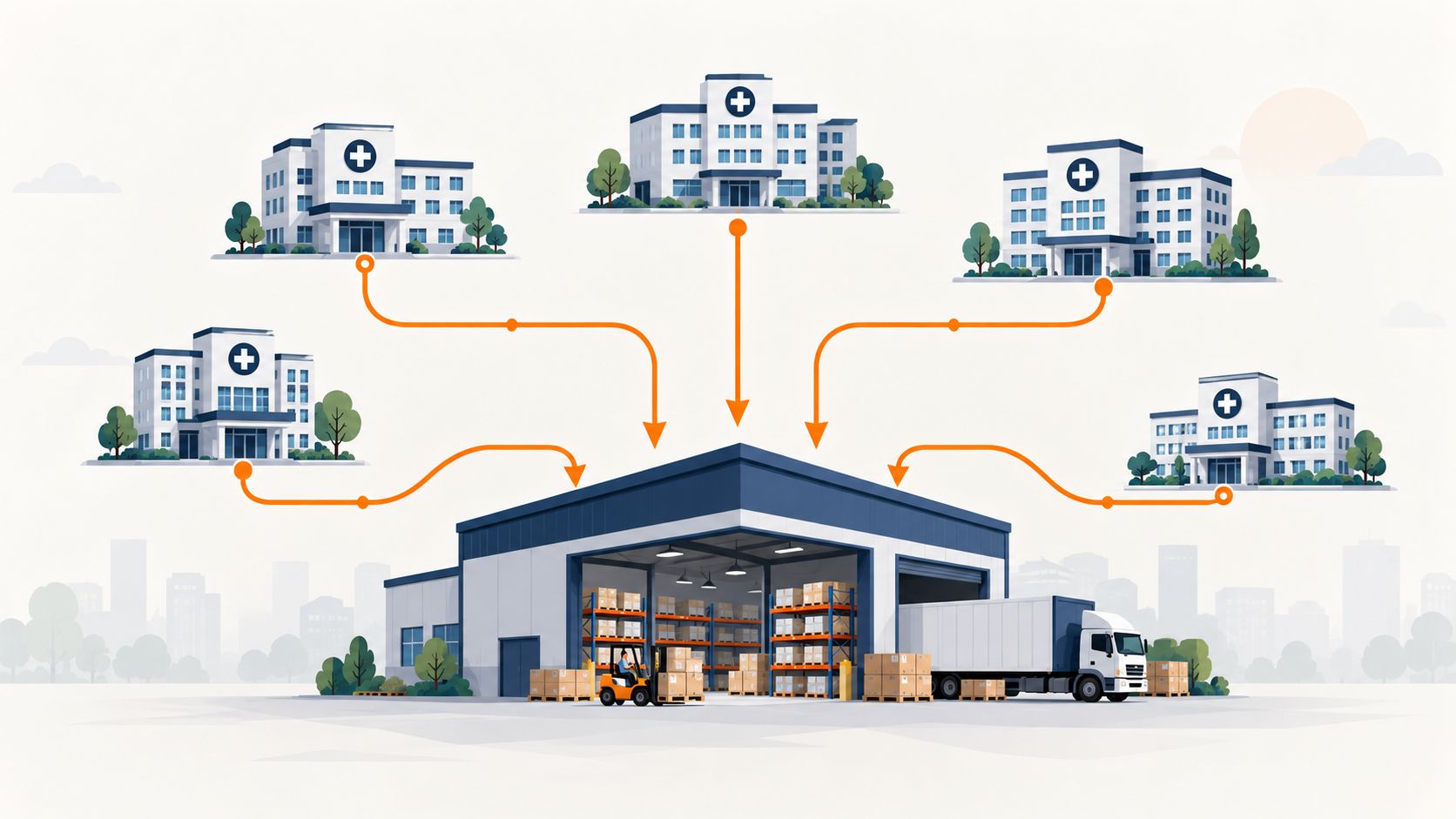
Pooled procurement solves the volume gap without asking any hospital to give up independence, change its billing systems, or merge with anyone else. The mechanism is simple:
- A network of hospitals, clinics, labs, pharmacies, maternity centres and dental practices each place their own weekly consumables order.
- Those orders are combined into one pooled order against the full network's volume.
- That combined volume is what gets negotiated against supplier rate cards, not any single hospital's order size.
- Each member receives their own order, at the pooled rate, on a fixed weekly schedule.
Every hospital still chooses what it orders and how much. What changes is the price it pays for ordering it, because the price is now set by the network's combined volume rather than its own.
How H.O.P.E. Runs This for Rajasthan
H.O.P.E., short for Hospital-Oriented Procurement Ecosystem, is HOSPkart's pooled procurement network built specifically for Tier 2 and Tier 3 hospitals, clinics, labs, pharmacies, maternity centres and dental practices, with a current network of 100-plus member facilities.
The weekly cycle
- Friday: place your weekly order before end of day.
- Weekend: network orders are pooled, packed and dispatched to suppliers.
- Monday: supply reaches your hospital's doors, every week, on schedule.
This single, predictable cycle replaces the usual pattern of ad-hoc calls to multiple vendors whenever stock runs low, which is also where most panic buying, and its higher prices, comes from.
What is covered
The network's procurement audit and ongoing ordering covers roughly 100 SKUs across the categories every member facility uses most: gloves, syringes, IV sets, dressing material, oxygen consumables and similar recurring items.
Membership options
- H.O.P.E. Lite, a flat monthly fee with transparent, fixed rate-card pricing and no hidden per-order charges.
- H.O.P.E. Pro, an annual membership that includes a minimum guaranteed saving on yearly procurement, with a fee refund if that guarantee is not met.
Pooled Procurement vs a Traditional GPO: What Is Actually Different
Group purchasing organisations are not a new idea, they are well established in the United States and increasingly discussed in Indian healthcare circles. But most GPO models are built around large hospital chains negotiating with a handful of national suppliers, and they rarely reach standalone Tier 2 and Tier 3 facilities at all.
H.O.P.E. is built the opposite way round: it starts from the smaller, independent hospital that a traditional GPO structure was never designed to serve, and pools exactly the volume that facility generates, alongside similar facilities, into one negotiated order. The weekly Friday-to-Monday cycle and the free audit before joining are both direct answers to the two biggest reasons smaller hospitals stay out of group buying: not knowing if it will actually save them money, and not wanting to hand over ordering control to a system built for someone else's scale.
If you are comparing the two models more formally before deciding, our detailed guide on group purchasing organisations in India on HOSPkart covers the traditional GPO structure in full, so you can weigh it against the pooled model here.
Start With a Free Audit, Not a Commitment
Before joining, every hospital can request a free 100-SKU procurement audit. This benchmarks your current consumables spend against institutional rates the network already negotiates, so you can see your potential saving in numbers, on your own items, before deciding anything. You do not need to switch every vendor to request it, and you do not need a perfectly organised set of purchase bills ready on day one either. Our detailed walkthrough of how the free audit actually works covers exactly what happens after you apply.
Who This Is For
Pooled procurement through H.O.P.E. is built for:
- Hospitals and nursing homes, particularly 20 to 100-bed facilities where consumables spend is significant but not large enough to negotiate independently.
- Diagnostic labs, ordering reagent-adjacent consumables and general disposables at regular intervals.
- Pharmacies, managing recurring stock beyond prescription medicines.
- Maternity centres, with a predictable, high-frequency consumables list tied to delivery volume.
- Dental practices, ordering a smaller but still recurring consumables basket.
If your facility is RGHS or MAA Yojana empanelled, this matters even more. Package rates under these schemes are fixed per procedure, which means procurement cost is one of the only levers left to protect your margin. Our guide on RGHS and MAA Yojana package rates and procurement margin looks at this specifically for Rajasthan facilities.
Frequently Asked Questions
How is pooled procurement different from just negotiating with my current supplier?
Negotiating alone still caps out at your own order volume. Pooled procurement combines your order with every other member hospital's order before it reaches the supplier, so the rate reflects the network's total volume, not yours alone.
Do I have to switch every vendor to join H.O.P.E.?
No. You can move specific categories to the pooled network while keeping other vendor relationships in place. The free audit is designed to show you where the savings actually are before you decide what to shift.
Is the free procurement audit really free, with no obligation?
Yes. The audit benchmarks your current spend against institutional rates so you can see the potential saving before committing to membership. It does not require you to sign up.
How is H.O.P.E. different from a traditional group purchasing organisation?
Traditional GPOs are typically structured for large hospital chains. H.O.P.E. is built specifically for standalone Tier 2 and Tier 3 hospitals, clinics, labs, maternity centres and dental practices, run on a weekly Friday-to-Monday ordering cycle rather than long-term bulk contracts.
What happens after the audit shows visible savings?
You can choose to join as an H.O.P.E. Lite or H.O.P.E. Pro member and begin placing weekly orders against the network's rate card. Nothing changes automatically just because the audit shows a saving.
Looking for medical supplies in bulk?
Explore 5,000+ verified consumables with transparent GPO pricing on HOSPkart.
Related Articles
More insights on hospital procurement & supply chain optimization
 Procurement Guide
Hospital Consumables Supplier in Jodhpur and Western Rajasthan
Thinner vendor markets in Jodhpur, Barmer, Jaisalmer and Pali mean less pricing pressure, not more. See how pooled procurement changes that.
 Procurement Guide
Gloves, Syringes and IV Sets: How to Check if You Are Overpaying
Is your hospital overpaying for gloves, syringes and IV sets? Here’s how to benchmark your current pricing against an actual institutional rate card.
 Procurement Guide
Par Level Inventory for Hospitals: Setting Minimum Stock for Consumables
Learn the par level formula for hospital consumables, average usage plus safety stock divided by delivery frequency, with a worked example.
