


Panic Buying in Hospitals: The Hidden Cost of Emergency Orders
Emergency consumables orders are priced for urgency, not value. See how panic buying quietly inflates your hospital’s annual supply cost.
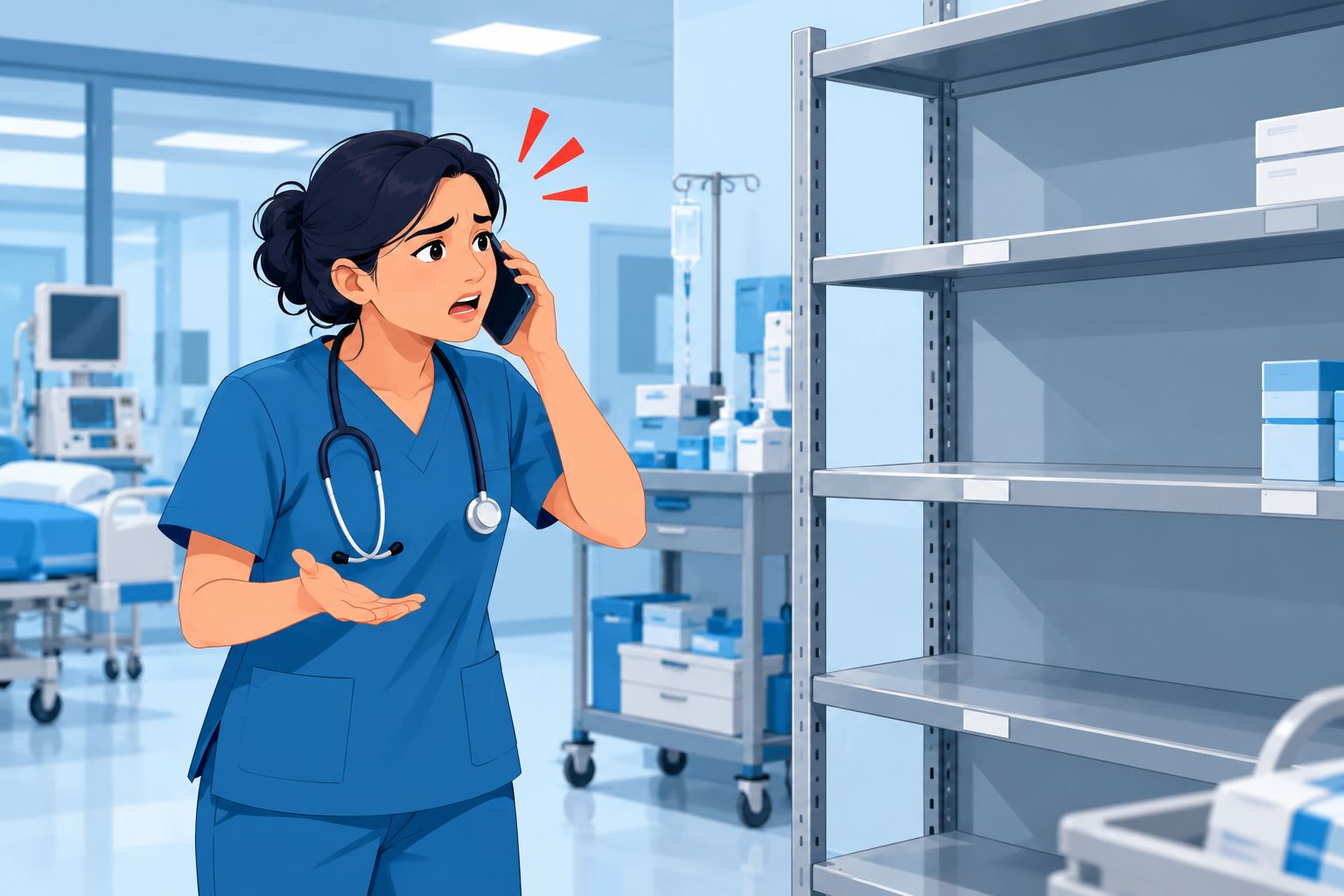
Emergency consumables orders are priced for urgency, not value, and since few hospitals track these orders as a separate category from routine purchasing, the premium paid blends invisibly into the general consumables line rather than appearing as an identifiable cost anyone actually sees and acts on. Every hospital has a version of this story: gloves run out on a Tuesday afternoon, someone calls three vendors in a panic, and whichever one answers first gets the order, at whatever price they quote. It feels like a one-off problem. Add it up over a year and it is usually one of the largest, least visible costs on a hospital's consumables bill.
Key Takeaways
- Emergency orders are priced for urgency, not value, vendors know you have little room to negotiate when stock is already out.
- The real cost of panic buying is rarely tracked as its own line item, which is exactly why it goes unaddressed for years at most facilities.
- A predictable weekly ordering cycle with a proper par level removes the structural reason panic buying happens in the first place.
- Seasonal demand spikes, like dengue season in Rajasthan, make panic buying's cost worse by putting an entire region's hospitals in competition for the same urgent supply at once.
Why Emergency Orders Cost More Than They Appear To
When a consumable runs out unexpectedly, the person placing the order is working against a clock, not a budget. Vendors quoting for an urgent same-day or next-day requirement price accordingly, and there is little room to compare quotes or negotiate when a ward genuinely cannot wait for a better offer. This is simple economics from the vendor's side, urgency removes your negotiating leverage entirely, and most hospitals accept the premium as the unavoidable cost of an emergency rather than recognising it as a cost that was actually avoidable through better planning in the first place.
Why This Cost Stays Invisible
Few hospitals track emergency or urgent orders as a separate category from routine ordering, so the premium paid on each panic order blends into the general consumables line on the books rather than appearing as its own distinct, trackable figure. A hospital that compares its average per-unit cost across a full year, including every emergency order placed during that period, is often paying noticeably more than its quoted routine rate for the same items, without any single invoice making that gap obvious at the time it was paid. This invisibility is precisely why the problem persists for years at many facilities, there is no single moment where the cost announces itself clearly enough to prompt a fix.
The Structural Fix: Par Levels and a Fixed Cycle
Panic buying is rarely a one-off mistake, it is usually a sign that a hospital has no defined minimum stock level, or par level, that triggers reordering before a shelf actually runs empty. Our guide on setting par levels for hospital consumables covers how to calculate this properly, using a formula based on your average usage rate and delivery lead time, rather than reordering only once someone happens to notice stock is running low. Paired with H.O.P.E.'s fixed Friday-to-Monday weekly ordering cycle, a hospital always knows exactly when its next delivery lands, which removes most of the uncertainty that leads to emergency ordering under normal, non-seasonal circumstances.
Seasonal Demand Makes This Worse, Not Different
During predictable seasonal spikes, dengue season being the clearest example in Rajasthan, the same panic buying pattern plays out across an entire region at once, which makes emergency pricing even less favourable since every hospital nearby is competing for the same urgent stock simultaneously, not just your own facility against a single vendor's limited patience. Our guide on dengue season stock planning covers how to plan ahead of this specific pattern rather than reacting to it once the regional supply pressure has already begun.
Why Awareness Alone Rarely Fixes the Problem
Most hospital administrators, when asked directly, will readily agree that panic buying is expensive and worth avoiding. Yet the pattern persists at the majority of facilities, which suggests the gap is not primarily about awareness, it is about the absence of a concrete structural alternative that makes avoiding panic buying easier than falling back into it under pressure. Simply telling staff to "order earlier" without giving them a defined par level and a predictable delivery schedule to plan against leaves the underlying problem untouched, since the staff member facing a low shelf still has no clear trigger point to act on before the situation becomes urgent. This is why the fix that actually works tends to be structural, a defined reorder threshold and a reliable delivery cycle, rather than a reminder or a policy memo asking staff to simply be more careful going forward.
Calculating Your Own Facility's Panic Buying Cost
If your facility has never tracked emergency orders separately, a useful first exercise is reviewing the past six to twelve months of purchasing records and flagging any order that was placed urgently, outside your normal ordering rhythm, due to a stock-out or near stock-out. Comparing the per-unit price on those flagged orders against your normal routine rate for the same items gives a concrete, facility-specific figure for what panic buying has actually cost you, rather than relying on a general sense that "it happens sometimes." Many administrators who complete this exercise for the first time are surprised by the total, since the cost of any single emergency order rarely feels large in isolation, but the cumulative figure across a full year, once properly tracked, often tells a very different story.
The Emotional Pattern Behind Reactive Ordering
It is worth acknowledging a less-discussed factor behind panic buying: the staff member who discovers stock has run out is usually under real time pressure, sometimes with a patient waiting, and their priority in that moment is resolving the immediate problem, not negotiating the best possible price. This is an entirely understandable response to the situation they are in, and it is not a fair criticism of that individual staff member's judgement. It is, however, a reason the fix needs to happen upstream of that moment, through a par level and ordering system that prevents the shelf from reaching empty in the first place, rather than relying on a stressed staff member to somehow negotiate calmly and effectively in the middle of an actual supply crisis.
A Simple Diagnostic: Does Your Facility Have a Panic Buying Problem?
A few quick questions can help a hospital administrator gauge whether this guide's concerns actually apply to their own facility, without needing a full audit first. Does your facility place urgent consumables orders more than occasionally, rather than as a rare exception? Do staff describe running out of specific items, gloves, IV sets, specific diagnostic kits, as something that "just happens sometimes"? Is there no written par level or reorder threshold documented for your core consumables categories? A facility answering yes to more than one of these is very likely paying a real, if currently untracked, panic buying premium, and would benefit from the tracking exercise and structural fix described above.
Frequently Asked Questions
How much more do hospitals typically pay for emergency orders versus routine ones?
This varies by item and vendor relationship, but the premium is rarely zero, and it compounds across every stock-out over a year. Tracking emergency orders as a separate category for even a few months is usually enough to see the real figure for your own hospital.
Is panic buying really avoidable, or does every hospital face unexpected demand sometimes?
Unexpected demand will always happen occasionally, but most panic buying traces back to not having a defined par level and reorder point, which is a planning gap, not an unavoidable event beyond a facility's control.
Does a weekly ordering cycle fully eliminate the need for emergency orders?
It significantly reduces the frequency by making the next delivery predictable, but a genuine, unplanned demand spike can still require an exception order occasionally. The goal is reducing how often this happens, not promising it never will under any circumstance.
Why do staff keep falling back into reactive ordering even when they know it costs more?
Without a concrete structural alternative, a defined par level and a predictable delivery cycle, staff facing a low shelf have no clear earlier trigger point to act on. Awareness alone rarely changes behaviour without a system that makes the better option the easier one.
How do I start tracking panic buying cost if my facility has never done this before?
Review recent purchasing records for any order placed urgently due to a stock-out, compare its per-unit price against your routine rate for the same item, and total the difference across as many months of records as you have available. This gives a concrete starting figure to work from.
Is it fair to blame staff for panic buying when it happens?
Generally not. A staff member resolving an urgent stock-out under time pressure is focused on the immediate problem, not price negotiation, which is a reasonable response to the situation. The actual fix is a system, a par level and predictable ordering cycle, that prevents the shelf from reaching empty in the first place, rather than relying on individual staff behaviour in the moment.
What is the quickest way to tell if my facility has a panic buying problem worth fixing?
If urgent consumables orders happen more than occasionally, staff describe stock-outs as routine rather than rare, and your facility has no documented par level for core categories, you very likely have an untracked but real panic buying cost worth investigating.
Panic Buying Beyond Consumables: A Pattern Worth Recognising Elsewhere
While this guide focuses on recurring consumables, the same underlying pattern, reactive purchasing under time pressure leading to a worse price, can show up in other areas of hospital procurement too, including equipment replacement parts or urgent diagnostic supplies outside the regular consumables list. Recognising panic buying as a general pattern, rather than a problem specific to gloves or IV sets alone, can help a facility apply the same structural thinking, planning ahead with a defined threshold rather than reacting once something has already run out, more broadly across its procurement practices, not just the categories covered directly in this guide.
Looking for medical supplies in bulk?
Explore 5,000+ verified consumables with transparent GPO pricing on HOSPkart.
Related Articles
More insights on hospital procurement & supply chain optimization
 Procurement Guide
Hospital Consumables Supplier in Jodhpur and Western Rajasthan
Thinner vendor markets in Jodhpur, Barmer, Jaisalmer and Pali mean less pricing pressure, not more. See how pooled procurement changes that.
 Procurement Guide
Gloves, Syringes and IV Sets: How to Check if You Are Overpaying
Is your hospital overpaying for gloves, syringes and IV sets? Here’s how to benchmark your current pricing against an actual institutional rate card.
 Procurement Guide
Par Level Inventory for Hospitals: Setting Minimum Stock for Consumables
Learn the par level formula for hospital consumables, average usage plus safety stock divided by delivery frequency, with a worked example.
