


Consumables vs Equipment Procurement | H.O.P.E.
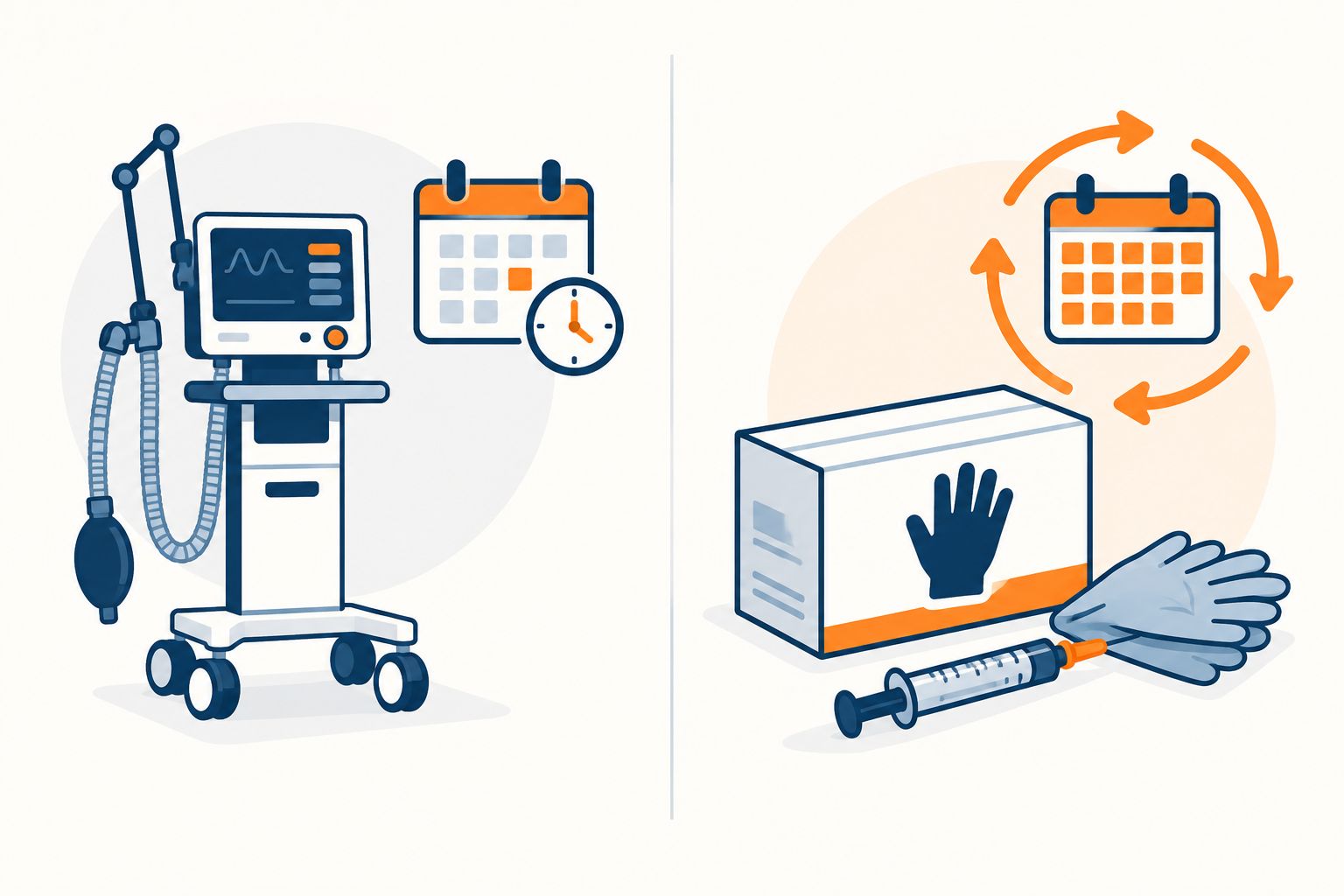
Why hospitals need separate strategies for equipment and consumables procurement, and which platform fits each.
Most hospitals treat procurement as one job. In practice, it is two very different jobs wearing the same job title. Buying a ventilator and buying a box of gloves look similar on a purchase order, but they behave nothing alike financially, and buying them the same way is where a lot of avoidable cost quietly builds up.
Key Takeaways
- Equipment is a one-time or periodic purchase, evaluated on total cost of ownership over years.
- Consumables are a recurring, weekly purchase, where the price paid this week is paid again every week, indefinitely.
- Treating both categories with the same procurement process means either overpaying on the recurring side or under-planning on the equipment side.
- Splitting the two, one platform for equipment, one pooled network for consumables, is a structural fix, not an extra process.
Two Categories, Two Different Cost Behaviours
Equipment, a ventilator, a hematology analyzer, an OT table, is bought infrequently and evaluated over a multi-year lifespan. The purchase decision has time to be researched, compared and negotiated, because it only happens once every few years for that item.
Consumables, gloves, syringes, IV sets, dressing material, are bought every single week, indefinitely, for as long as the hospital operates. A small inefficiency here does not happen once, it repeats fifty-two times a year, every year, which is exactly why a modest price gap on consumables compounds into a large annual cost far faster than an equivalent gap on equipment ever could.
Why the Same Procurement Process Fails Both Categories
A procurement process built around infrequent, high-consideration equipment purchases is too slow and too research-heavy for weekly consumables ordering, which is exactly why consumables ordering tends to drift into reactive, ad-hoc purchasing instead. And a procurement process built around fast, low-consideration weekly ordering is not the right process for a ventilator or an analyzer, where the wrong choice is expensive to reverse for years.
Running both through one undifferentiated procurement habit usually means the hospital either over-researches small recurring purchases and still ends up buying them reactively when stock runs low, or under-researches equipment purchases because the buying habit is built for speed, not evaluation.
The Fix: Two Platforms, Two Different Jobs
Equipment: evaluate against total cost of ownership
Equipment purchases should be compared on landed cost, service support and expected lifespan, not sticker price alone. Our sister marketplace, HOSPkart, is built specifically for this: verified sellers, comparable listings, and pan-India delivery for one-time and periodic equipment purchases. If you are researching a specific category, our hematology analyzer buying guide is a recent example of the kind of comparison equipment purchases deserve.
Consumables: evaluate against combined order volume
Consumables purchases should be evaluated on rate-card pricing driven by total order volume, not on any single week's quote. This is precisely what H.O.P.E.'s pooled procurement network is built for, combining a hospital's weekly order with a wider network's volume to reach pricing a standalone hospital cannot negotiate alone. Our guide on what pooled procurement actually is explains the mechanism in full, and our explainer on why Tier 2 hospitals pay 30 to 40 percent more for consumables shows exactly what this split is protecting you from.
A Simple Test for Any Purchase
When deciding which process a purchase belongs to, one question settles it: will you buy this again next week, regardless of what happens this week? If yes, it is a consumable, and it belongs in a volume-pooled, planned weekly cycle. If no, it is equipment, and it belongs in a researched, compared, total-cost-of-ownership decision. Most procurement confusion in smaller hospitals comes from not asking this question explicitly before deciding how to buy something.
Frequently Asked Questions
Are there items that fall between equipment and consumables?
Yes, some items, like reusable minor instruments or accessories replaced every few months rather than weekly, sit in between. As a practical rule, if replacement frequency is monthly or longer, evaluate it more like equipment, with total cost of ownership in mind; if it is weekly, treat it as a consumable and evaluate it on volume-based pricing.
Should a hospital use both HOSPkart and H.O.P.E.?
For most Tier 2 and Tier 3 hospitals, yes, they solve two different procurement problems. HOSPkart is suited to equipment purchases, while H.O.P.E. is suited to recurring consumables ordering, and using each for what it is built for avoids the common mistake of running both categories through one process.
Why does splitting these two categories actually save money, rather than just being tidier?
Because each category is priced differently by suppliers. Equipment pricing rewards research and comparison; consumables pricing rewards volume and consistency. Applying the wrong lever to each category means leaving savings on the table in both places, not just one.
Looking for medical supplies in bulk?
Explore 5,000+ verified consumables with transparent GPO pricing on HOSPkart.
Related Articles
More insights on hospital procurement & supply chain optimization
 Procurement Guide
Hospital Consumables Supplier in Jodhpur and Western Rajasthan
Thinner vendor markets in Jodhpur, Barmer, Jaisalmer and Pali mean less pricing pressure, not more. See how pooled procurement changes that.
 Procurement Guide
Gloves, Syringes and IV Sets: How to Check if You Are Overpaying
Is your hospital overpaying for gloves, syringes and IV sets? Here’s how to benchmark your current pricing against an actual institutional rate card.
 Procurement Guide
Par Level Inventory for Hospitals: Setting Minimum Stock for Consumables
Learn the par level formula for hospital consumables, average usage plus safety stock divided by delivery frequency, with a worked example.
